
Buying a Concrete Mixer Truck: Which Capacity Figures Matter?
Compare the exact mixer's nominal concrete capacity, then check drum-volume definitions, complete-vehicle weights and chassis compatibility. The largest cubic-metre figure is not automatically the concrete load you can carry.
Compare the same named capacity on each offer
Start with the nominal concrete capacity stated for the exact mixer model. Ask the supplier to identify the manufacturer's term, units and loading conditions on a dated specification sheet. A quotation saying only '12 cubic metres' leaves an important question unanswered: which volume does that number describe?
Liebherr's HTM 904 page illustrates the distinction: it lists 9 m³ nominal filling, 10.22 m³ water capacity and 15.96 m³ geometric drum capacity. These are three different specifications for that particular mixer. They are not interchangeable, and they do not establish the capacity of a vehicle pictured in another catalogue.
Keep drum volume and the water tank in separate fields
CIFA's SL/SLA technical sheet lists geometric volume and water-line volume in cubic metres, while the water tank is listed separately in litres. The water-line figure is a drum-volume specification; it is not the capacity of the truck's separate water tank. Request the same distinction whenever translated sales descriptions use the word 'water'.
Record each original label alongside its translated meaning. Do not apply an assumed conversion ratio between geometric volume and nominal concrete capacity. If an offer supplies only an overall drum volume, request the model-specific concrete-capacity figure before using it to compare vehicles.
Check the complete truck's weight and axle information
Concrete volume alone does not describe the loaded truck's mass. Ask for the proposed concrete density and load mass, plus the complete vehicle's unladen or operating-weight definition. Clarify how the quotation accounts for the fitted mixer, options, fuel, water, crew and other carried equipment; an empty mixer-body weight is not a complete-truck weight.
Request a documented check of the proposed loaded total and individual axle loads. CIFA's chassis guide labels its figures as technical permissible weights. Have a competent local specialist also check the destination's applicable road requirements. Neither a technical rating nor a 6×4 or 8×4 badge, by itself, confirms the permitted concrete load for your route.
Confirm the mixer and chassis are a matched configuration
Identify both the exact chassis model and the mixer-body model. CIFA's matching guide separates chassis layouts, minimum wheelbases, compatible mixer versions and drive arrangements. Ask for the offered combination's installation drawing and the relevant manufacturer's confirmation, rather than treating axle count as a complete compatibility check.
Clarify whether the drum drive uses the chassis power take-off or a separate auxiliary engine, and which equipment is included. Ask the supplier to resolve any missing chassis or drive requirement in writing. Keep the drawing and specification revisions together so a later substitution does not silently change the configuration being compared.
Request a quotation with clearly labelled figures
Send every supplier the same brief: intended concrete load, work locations, route, quantity and destination. Request separate entries for nominal concrete capacity, geometric volume, water-line volume, water-tank litres, complete-vehicle weight, axle information and the body/chassis references. Mark estimates and outstanding checks instead of presenting them as confirmed figures.
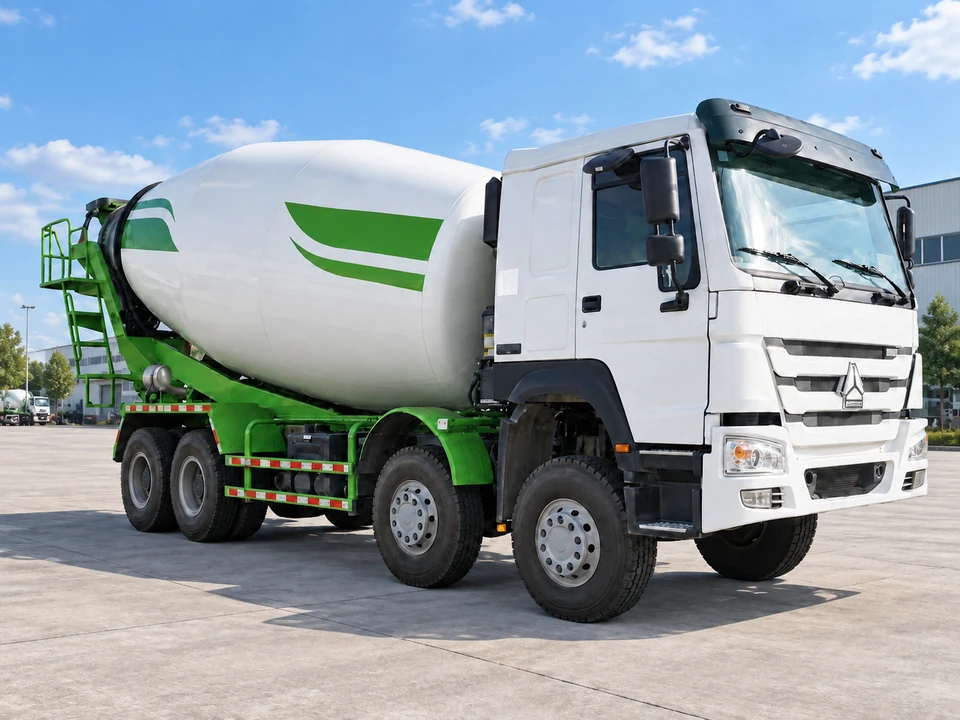
The photograph on this page illustrates a catalogue mixer truck; it does not verify a particular drum capacity or payload. Compare the actual offered specifications and supporting documents before deciding which quotation meets your requirements.