
Own a Mixer Truck or Buy Ready-mix Delivery? Check the Whole Supply Plan
Owning a drum mixer truck does not by itself secure concrete production or uninterrupted deliveries. Before buying, confirm the batching and supply arrangement, quality responsibilities and realistic delivery schedule. Compare complete ownership and delivered-concrete costs for the same projects; daily demand alone is not enough to decide.
Define the truck's role in concrete production
A conventional drum truck can have different duties. NRMCA distinguishes truck-mixed concrete, partially plant-mixed concrete completed in the truck, and concrete mixed at a central plant with the truck primarily providing agitation during transport. Therefore, neither a delivery-only description nor a claim that the truck replaces the production system is a sufficient purchasing brief.
Draw the proposed flow from material batching to mixing, transport and placement. State who supplies and measures the ingredients, where mixing is completed and who releases each load. This guide concerns conventional drum trucks; a mobile volumetric batching unit is a different equipment arrangement. Ask the supplier to identify the exact type offered before comparing business scenarios.
Confirm a supply agreement and quality responsibilities
If your truck will collect concrete or batched materials from another producer, obtain written loading arrangements before assuming access. Confirm opening hours, booking procedures, available loading slots and how shortages or interruptions will be handled. If you plan your own batching operation, budget and assess that operation separately from the truck purchase.
Have the project team and concrete producer agree the required mixture, identification records, acceptance checks and responsibility for adjustments. The NRMCA/ASCC ordering checklist includes mix identification and specified fresh-concrete properties. Use the actual project requirements rather than copying an example specification. Owning the vehicle does not establish that the concrete will meet those requirements.
Build a dispatch plan around the site, not just the drum
List loading and queuing time, outward travel, site waiting, discharge, washout and the return journey for the proposed route. Use observed or supplier-confirmed times and identify uncertain items. Compare that cycle with the required placement rate and pour schedule. Do not turn a drum-volume label into a promise of concrete delivered per day.
The NRMCA/ASCC checklist separately records truck spacing, placement rate, site access, placement method, washout areas and emergency contacts. Confirm these with the site and producer, including what happens when a truck, plant or placement operation stops. Agree delivery conditions for the actual mix and project; a generic journey-time assumption cannot establish concrete acceptance.
Compare costs with the same scope and workload
For delivered ready-mix, request the concrete and transport scope, minimum-load terms, waiting charges, cancellation conditions and any charges for returned material. The NRMCA/ASCC checklist identifies several of these commercial questions. Clarify whether pumping or other placement services are included. Compare written offers for the same mixture, quantity, sites and delivery pattern.
For ownership, separately estimate vehicle acquisition or finance, drivers, fuel, maintenance, tyres, insurance, cleaning arrangements, downtime and backup transport. Include concrete or material supply and any separately planned batching operation without counting the same cost twice. Compare a common operating period with both busy and quiet workloads. Treat resale values and utilisation as assumptions to test, not guaranteed savings.
Write the whole operating plan into the buying brief
Liebherr lists concrete mixing plants, truck mixers, pumps, conveyors and residual-concrete recycling systems as separate product areas. Use that distinction to ask which functions your plan needs and which equipment or services are actually included. A truck quotation should identify its own scope; it should not silently stand in for a complete concrete business.
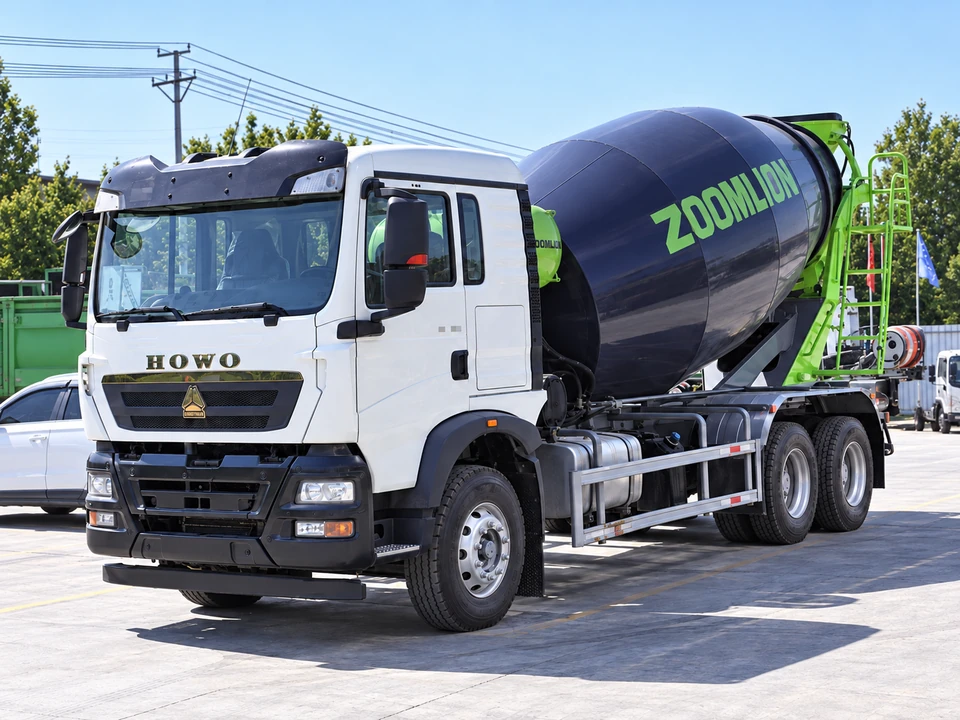
Prepare one brief covering supply access, quality responsibilities, site and dispatch requirements, realistic workload, cost assumptions and backup arrangements. Then request the appropriate truck configuration and documents. The HOWO TX mixer photograph is a catalogue illustration, not proof of a complete batching or delivery package. No fixed daily volume makes ownership automatically preferable to purchasing delivered concrete.