Buying a Container Trailer: Match Container Types, Lock Positions and Load Cases
Match the exact container and intended loading position to the trailer offered, rather than relying on a 20-foot or 40-foot label. Request a lock-layout drawing, the manufacturer's supported configurations and vehicle-specific load evidence. A photograph or a headline payload figure cannot confirm that every container arrangement is suitable.
Describe the actual containers before choosing the trailer
List each container type, length, height, underframe arrangement and intended loaded mass. Provide identification details, dimensioned information and clear photographs where available. Distinguish one container from a pair, and identify any tunnel in the container underside. A length designation alone leaves important compatibility questions unanswered.
For example, KRONE describes its eLTU45-2 with an additional front extension for 45-foot containers with a long tunnel and expressly excludes short-tunnel 45-foot containers on that design. This is a limitation of that named model, not a rule for every trailer. Ask the offered trailer's manufacturer to confirm your exact container variants in writing.
Request a drawing of the included locks and supports
Ask for a marked plan showing the container support and locking positions for each proposed arrangement. Identify the fitted lock types, their locations and any required adapters or additional supports. JOST explains that twist locks connect containers to the carrier vehicle. Do not confuse those locks with the tractor-to-trailer coupling or treat ordinary lashing points as container locks.
Separate fitted equipment from options. KRONE lists centre-position 20-foot locking equipment as optional for its eLTU40-2/45-2 range. That illustrates why a multi-length brochure is not proof of an individual trailer's equipment. Request current photographs matching the drawing, and ask which combinations are excluded when the quoted locks or supports are absent.
Check the load case for every intended position
Ask for a separate assessment of each intended case: a single container in a supported position, two containers, or containers with different loaded masses. State the actual masses and positions rather than assuming every arrangement shares one payload allowance. KRONE's TU6 manual describes an individually calculated vehicle load plan and warns that different loading conditions can substantially change axle loads.
Request the applicable trailer and tractor limits, vehicle documents and load-distribution evidence. Have a competent specialist check the proposed combination and destination requirements; obtain weighing evidence where needed. The TU6 manual concerns a different chassis family from the eLTU40-2/45-2 product example. Its position instructions must not be transferred to another model or to the illustrated flatbed trailer.
Verify the configuration and condition of moving equipment
If the offered chassis has extensions, folding locks or movable supports, obtain the manual and configuration diagrams for that exact version. Ask the supplier to identify the permitted transport settings and how their condition is verified. A photograph showing the trailer extended does not prove which loaded configurations the manufacturer permits.
For a used trailer, request dated inspection findings for the frame, lock mountings, locks and any extension or position-locking equipment. Have unexplained damage, alterations or missing components reviewed by a qualified workshop before accepting compatibility claims. JOST directs users to the relevant vehicle operating manual; a general buying checklist is not a substitute for the model's operating and inspection instructions.
Put the supported arrangements in the written offer
Compare offers using the same container list, lock-layout drawing, supported loading positions, mass cases and included equipment. Record excluded container variants and unresolved checks. Specify whether the quoted trailer is fixed or extendable and which manuals, inspection records and configuration drawings will be supplied. Confirm the tractor connection and brake interfaces separately without treating them as proof of container compatibility.
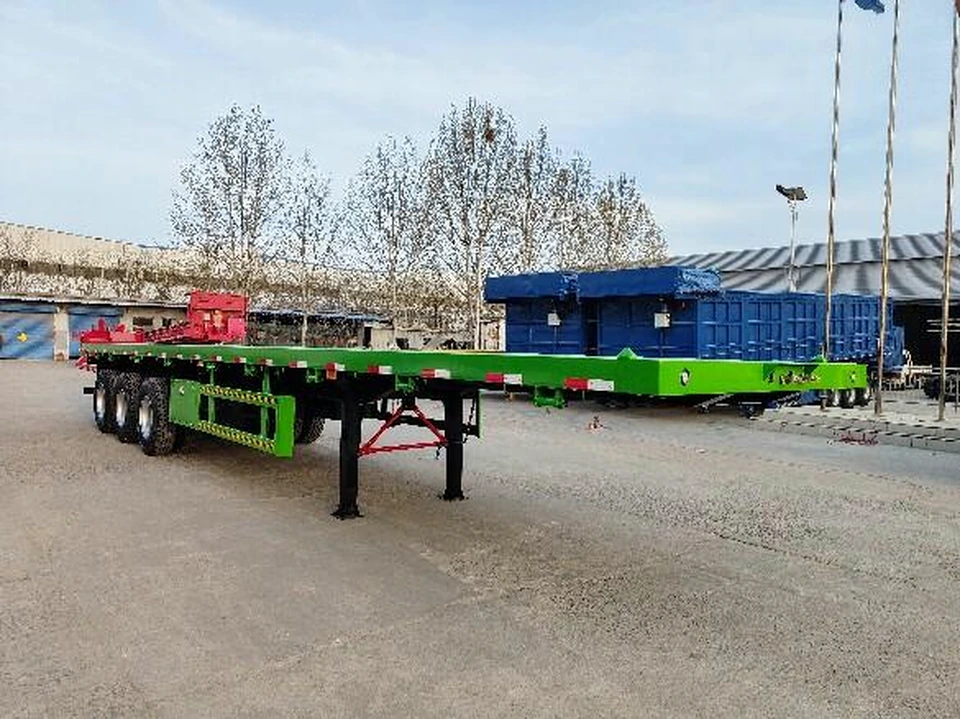
Include the proposed containers, their loaded masses, loading locations, route and destination in the enquiry. Request confirmation for the actual offered trailer rather than a similar brochure model. The catalogue photograph illustrates a container flatbed semi-trailer; it does not establish KRONE construction, JOST equipment, supported container positions or the load ratings of a vehicle offered for sale.